A wrist camera gives a robot a close-up, but one that is tied to its hand. What if the policy could decide where to look?
We present FoveaVLA, a vision-language-action model that replaces the wrist camera with a learned foveation action. Alongside every action chunk, it predicts the interaction region it will need to see at the next policy query, then crops that region from the original-resolution external image. The policy thus receives both the full view for scene context and the crop for close-up detail, without a camera on the hand.
01 · Interactive
See what FoveaVLA sees
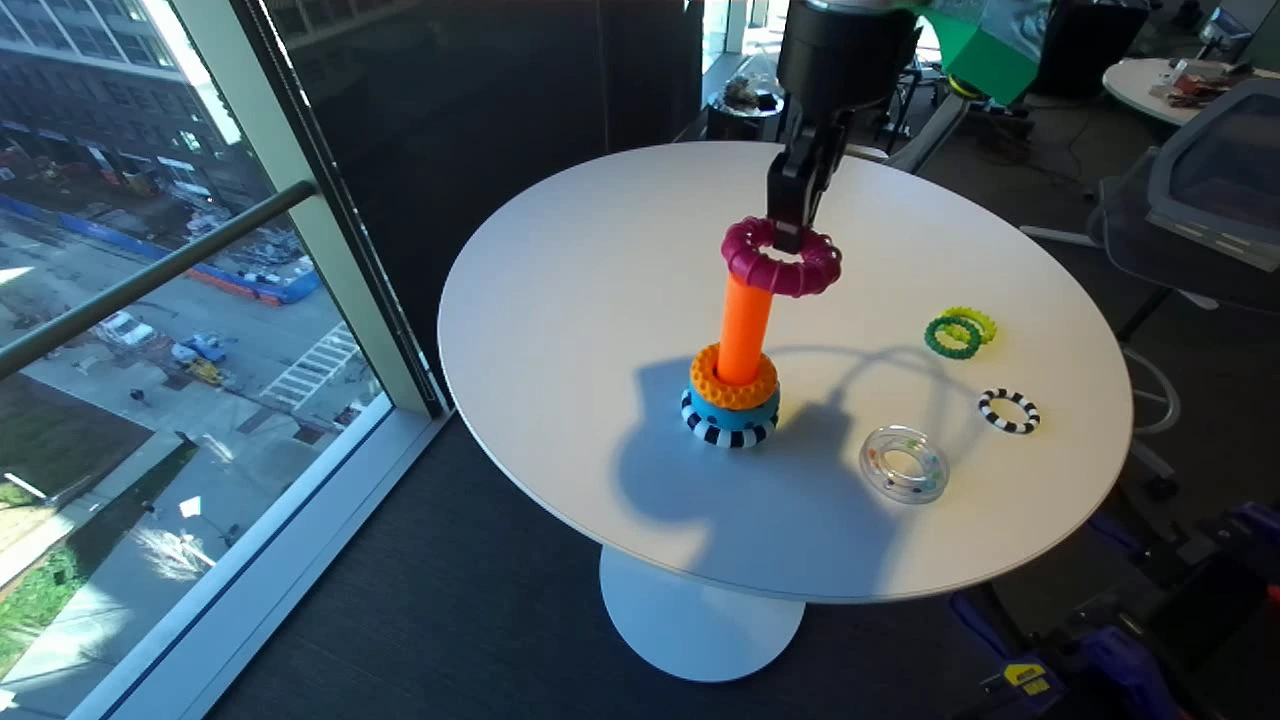
Pick a rollout from the benchmark and scrub through it. The box shows where the policy looked at each query; the inset is the exact foveal crop it received. Toggle depth to see the aligned depth crop.
All rollouts are autonomous episodes from the 48-trial real-world benchmark (trial numbers follow the paper's appendix). The crop updates once per policy query (every 8 control steps); boxes are recovered by matching each recorded crop to the full frame. The sparkline shows how much detail the crop adds over the resized full view. Playback is 1.5× real speed; the clock shows real robot time.
02 · Same task, same robot
Versus the wrist camera
The same benchmark trial, run by each policy. π0.5 sees an external camera and a wrist camera; FoveaVLA sees only one external camera and chooses where to look.
Same trial, same initial scene and instruction; one rollout per method. Each video plays at 1.5× real speed and can be paused or scrubbed on its own; the clocks show real robot time.
03 · Same pixel budget
Why crop? Resolution where the interaction happens
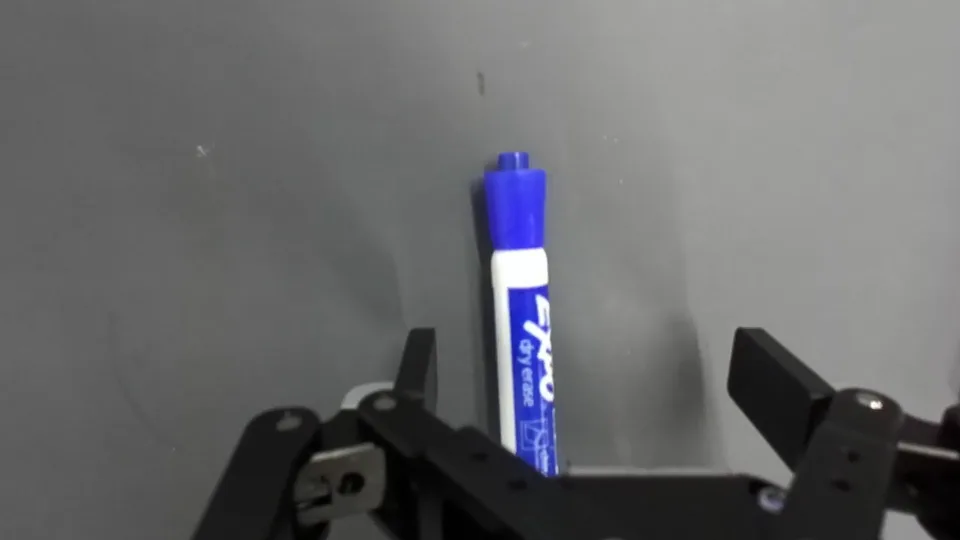
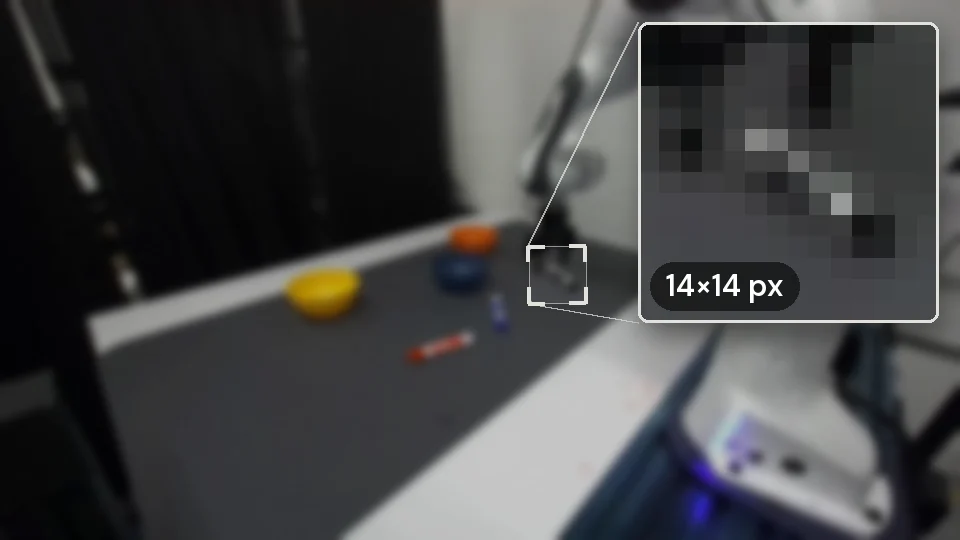
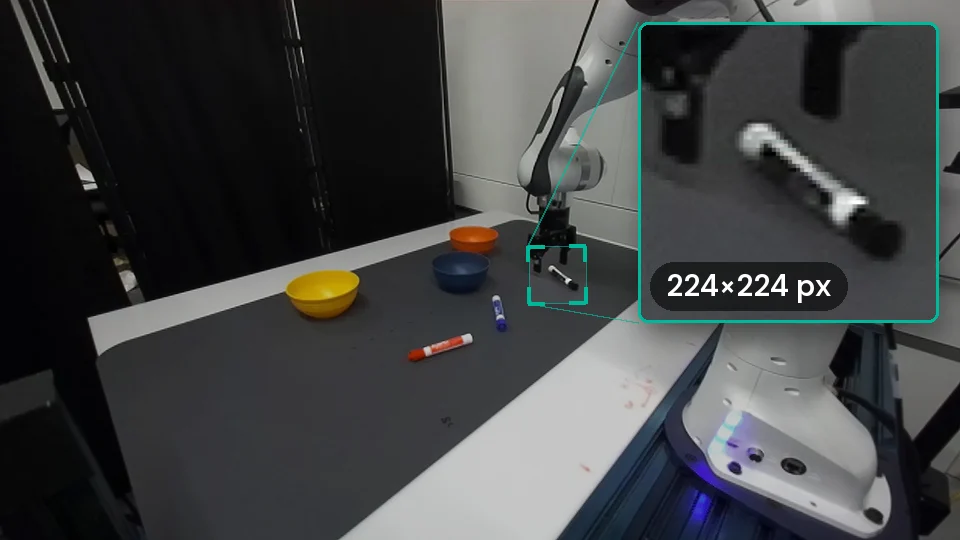
The vision encoder sees 224×224 pixels as a 16×16 grid of patch tokens. When a 1280×720 frame is resized, the interaction region covers only a few of these tokens; a crop of the same region from the original image covers all 256.
04 · Method
Learn where to look, alongside how to act
FoveaVLA builds on π0.5. From one shared observation it produces two outputs: an action chunk from the flow-matching action expert, and a foveation action, one box per external view, decoded with PaliGemma's existing location tokens.
Interaction boxes come from RoboInter annotations on DROID: the smallest rectangle enclosing the components each annotated skill requires, such as the gripper, the manipulated object, and the target region.
The target is the interaction region at the next query, because the gripper and objects move while the chunk executes.
Box tokens are decoded from the cached prefix while the robot executes the chunk, so the crop is ready when the next frame arrives.
05 · Results
Real-world evaluation
Four real-world suites on the DROID setup, 12 shared randomized trials each. Both FoveaVLA variants match the wrist-equipped baseline on plain pick-and-place and achieve higher success with distractors, cloth manipulation, and far-away objects.
What makes it work
With one external camera and no wrist view, removing either the foveal crop or depth lowers success substantially. With both, FoveaVLA-Single reaches 70.8%, above the wrist-equipped π0.5.
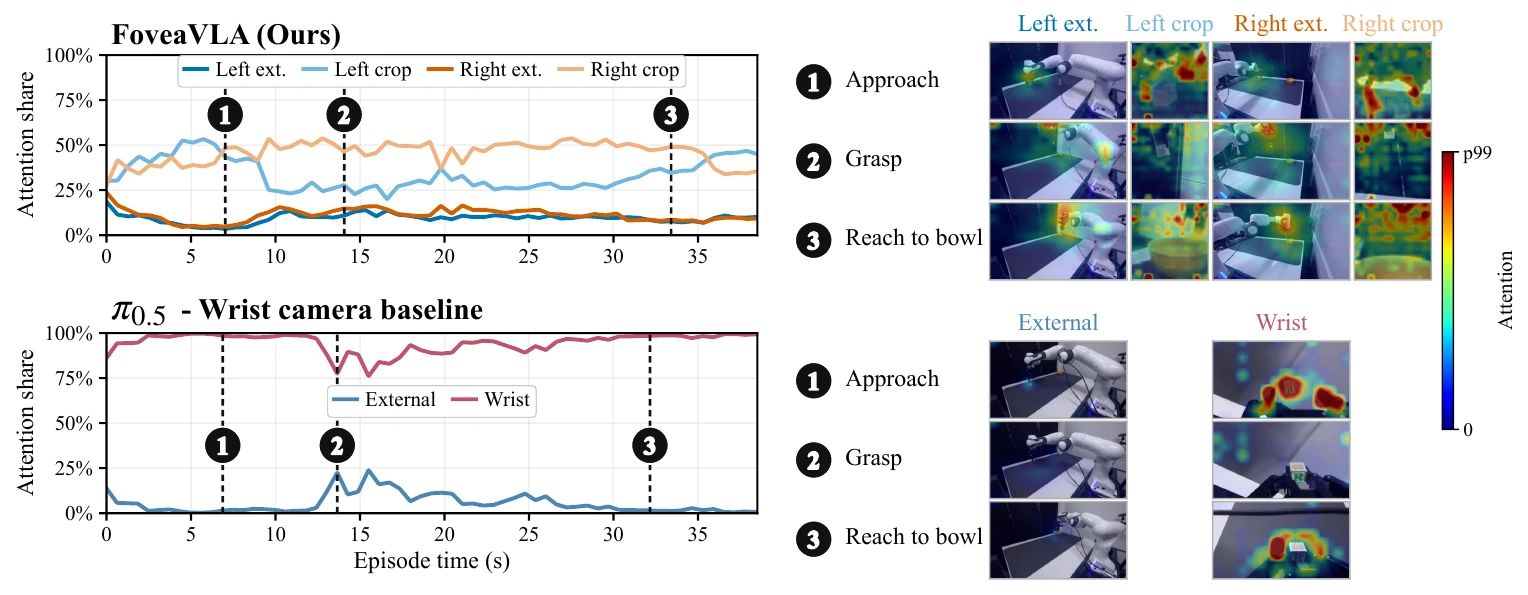
Where the policy attends
On a Move episode, π0.5 attends almost exclusively to the wrist view, so it can miss a target outside it. FoveaVLA keeps a steady share on the full external views, which cover the workspace, and draws close-up detail from the foveal crops.
Citation
@misc{chen2026foveavla,
  title         = {FoveaVLA: Foveation Actions Replace the Wrist Camera in VLAs},
  author        = {Bingao Chen and Lihan Zha and C. Karen Liu and Guy Tevet},
  year          = {2026},
  eprint        = {2610.20064},
  archivePrefix = {arXiv},
  primaryClass  = {cs.RO},
  url           = {https://arxiv.org/abs/2610.20064}
}